

Steering the Pacific’s Tuna Future: The Leadership of FFA’s First PNG Director General
When Noan David Pakop took up the role of Director General of the Pacific Islands Forum Fisheries Agency (FFA) in November 2024, it was more than a change in leadership. It was a historic milestone. As the first Papua New Guinean to hold the position, Pakop brings both a deep personal connection to the Pacific’s tuna story and over 30 years of hands-on fisheries experience.
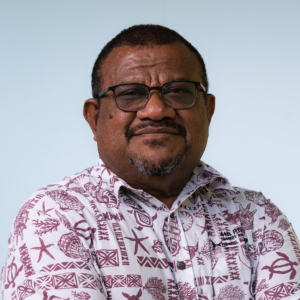
Noan David Pakop was appointed Director-General of the Pacific Islands Forum Fisheries Agency (FFA) by the Forum Fisheries Committee (FFC) Officials in May 2024 and formally endorsed by FFC Ministers in July 2024. Photo: FFA
Pakop’s journey began in the late 1980s as a young fisheries officer in Papua New Guinea’s National Fisheries Authority (NFA). Over the decades, he rose through the ranks, led regional surveillance efforts at the FFA, and steered national fisheries policies back home. Now, as the Secretariat’s 10th Director General, he inherits a mandate as vast as the ocean itself, safeguarding the Pacific’s US$3 billion tuna industry for the 17 Members that depend on it.
Pakop understands the stats, but what drives him goes beyond numbers. “Our leaders laid out a clear vision back in 1979 – that our people should enjoy the social and economic benefits of our fisheries, and that our resources must be managed sustainably,” he says. “It’s my responsibility to make sure that vision becomes reality- not just for today but for generations to come.”
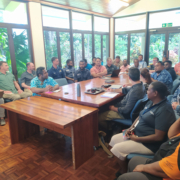
His return to FFA was far from ordinary. Just as he was preparing to take up the Director-General role, tragedy struck with the passing of his wife. Despite the personal loss, he stepped into the role with quiet determination, focussing on the work of the Secretariat – and leading his first two major Forum Fisheries Committee (FFC) meetings – the officials meeting in May and the ministerial meeting in July, both held in Niue. The FFC, is the governing council for FFA, and where Members set the Secretariat’s priorities and oversee its work.
A Critical Juncture for Pacific Fisheries
FFA’s 17 Members are custodians of a vast stretch of the Pacific Ocean that produces US$2-3 billion worth of tuna every year. In 2023 alone, tuna caught in their Exclusive Economic Zones (EEZs) was worth around US$2.9 billion. This wealth is the backbone of many Pacific economies, supporting jobs, government revenue and food security.
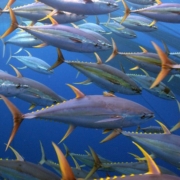
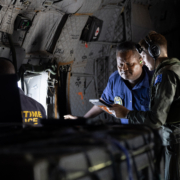
Despite mounting challenges, from climate change to shifting tuna stocks, the Pacific region has also achieved something rare on the global stage: all four key tuna stocks – skipjack, yellowfin, bigeye, and albacore remain healthy. This is the result of decades of coordinated management, innovative policies, strict fishing access rules, and regional surveillance operations such as Kurukuru and Tui Moana.
“Together, we have achieved something exceptional in global fisheries management; this is not just a win for the Pacific, it is a milestone of global significance. Our legacy stands as a testament to what we can achieve together and a foundation upon which we must continue to build,” said Pakop.
Illegal, unreported and unregulated (IUU) fishing remains one of the most significant threats to the Pacific, putting our tuna resources at risk. IUU fishing once drained more than $600 million a year from the region. This has been halved since 2016 – a rare success story in global fisheries
“In 2016, an estimated 306,440 tonnes of tuna, worth about $616.11 million, were taken through IUU activities in the Western and Central Pacific Fisheries Commission (WCPF) Convention Area. By 2021, those losses had been cut in half, with volumes dropping to 192,186 tonnes, valued at $333.49 million,” Pakop noted. This is the result of strengthened surveillance capabilities, data management, and engagement with other agencies, including customs, police, and drug enforcement, to strengthen joint efforts.
“One of the biggest measures of success in our region is our ability to collaborate,” Pakop reflects. “The only way to sustainably manage our vast resources is through cooperation and that’s been the key driver behind our success.”
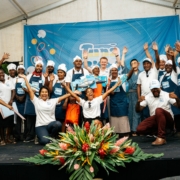
But as Pakop notes, sustainability is only half the story. The greater challenge is ensuring more of the economic benefits from tuna stay in the region. “In recent years, only around 15 percent of the tuna caught in our waters is processed onshore in our Member countries. That’s a gap we have to close. The more we can process and value-add here in the Pacific, the more jobs, income and skills we create for our people,” he says.
One way forward is the East New Britain Initiative (ENBi) which looks to build regional value chains by linking Member strengths – infrastructure, processing facilities, fuel supply, or fish access and services.
Pakop says the vision is to move away from a model where the catch leaves the Pacific unprocessed, towards one where more of the value is retained at home. It’s an approach that dovetails perfectly with the 2050 Strategy for the Blue Pacific Continent, which calls for a resilient, prosperous, and secure Pacific. For Pakop, it’s about moving from sustainability alone to sustainability plus development, ensuring that tuna doesn’t just feed the world, but also fuels the region’s growth.
Charting the Future
The next phase for the FFA Secretariat will be about resetting and refocusing, making the agency more agile, ensuring sustainable financing, and deepening engagement with Members to align fisheries work with national development priorities, according to Pakop.
“My focus will be on deepening engagement with our Members to better support their national development priorities. This includes identifying and strengthening development pathways through fisheries, guided by a cross-sectoral approach.” This direction is aligned with the vision set by our Leaders. “It’s an ambitious agenda, but one grounded in decades of practical experience and a lifetime of service to the region’s most valuable resource,” said Pakop.
For the man now steering one of the region’s important fisheries bodies, the task ahead is as vast as the ocean itself. But with decades of experience, a deep connection to the Pacific’s tuna story, and a commitment to working with Members and partners, Noan David Pakop is charting a steady course for the years to come.
FFA Members are: Australia, Cook Islands, Federated States of Micronesia, Fiji, Kiribati, Marshall Islands, Nauru, New Zealand, Niue, Palau, Papua New Guinea, Samoa, Solomon Islands, Tokelau, Tonga, Tuvalu and Vanuatu.
| Media Contacts: Emily V. Moli FFA Communications Manager e: [email protected] Ernest Ta'asi FFA Communications Officer e: ernest.ta’[email protected] Priscilla Ragu FFA Communications Officer e: [email protected] |  |
| About Pacific Islands Forum Fisheries Agency (FFA) FFA assists its 17 Members to sustainably manage fishery resources that fall within their 200-mile Exclusive Economic Zones (EEZs). FFA provides expertise, technical assistance and other support to its members who make decisions about their tuna resources and participate in regional decision making on tuna management. Find out more here: www.ffa.int |
|

 Elodie Van Lierde