Operation Rai Balang delivers strong start to 2026 Pacific fisheries surveillance
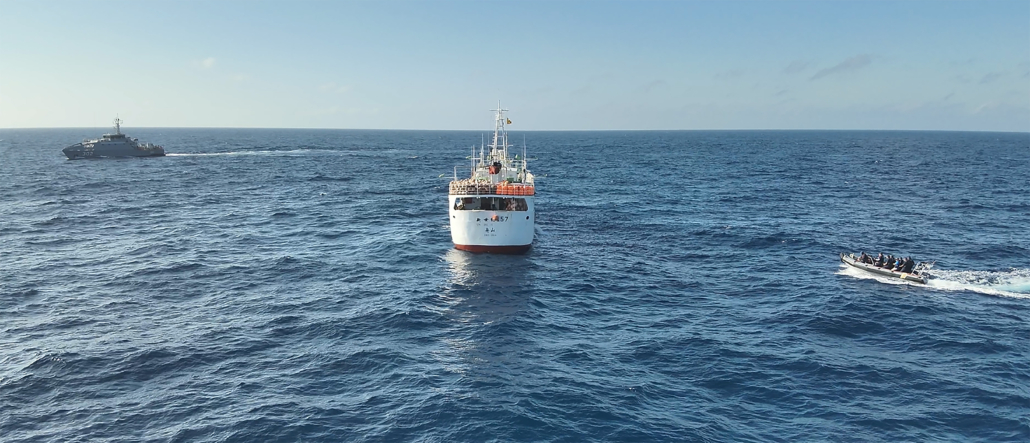
The Pacific Islands Forum Fisheries Agency (FFA) and its Members have begun 2026 regional fisheries surveillance efforts with strong, coordinated action, following the successful conclusion of Operation Rai Balang 2026 (OPRB26).
From 26 February – 13 March 2026, OPRB26 brought together FFA Members and regional partners in coordinated patrols and aerial surveillance covering approximately 13.3 million square kilometres of ocean across the Exclusive Economic Zones of the Federated States of Micronesia, Kiribati, Republic of Marshall Islands, Nauru, Palau, Papua New Guinea, Solomon Islands, and Vanuatu.
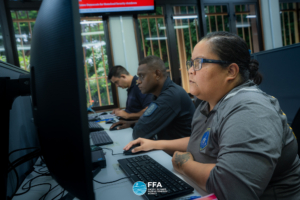
The operation involved coordinated surface patrols, aerial surveillance and intelligence analysis supported by the FFA Regional Fisheries Surveillance Centre (RFSC) at the FFA Headquarters in Honiara, Solomon Islands. Pictured are secondees that took part in the coordination of OPRB26 at the RFSC. Photo: FFA
The scope of the operation also covered adjacent high seas in the Western and Central Pacific Ocean.
Australia and New Zealand also supported OPRB26 through the Pacific Quadrilateral (PQUAD) partners, alongside France and the United States, contributing to patrol vessels, aircraft and surveillance support.
Preliminary results from the operation recorded 74 vessel inspections conducted both at sea and in port, along with 82 vessel sightings across the operational area.
Surveillance efforts also identified eight high risk vessels leading to seven vessels of interest flagged for Members’ further investigations and reporting to Flag States.
Three fishing vessels were apprehended for suspected violations requiring further investigation.
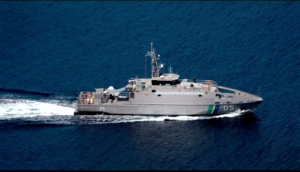
Deployment of RSIPV Gizo of the Solomon Islands during Operation Rai Balang 2026. Photo: Royal Solomon Islands Police Force
Operations such as Rai Balang form part of FFA’s ongoing regional monitoring, control and surveillance program, enabling Members to work together to verify compliance of fishing vessels. A strong emphasis of this operation was towards reporting requirements on effort and catches that are licensed to operate in the Pacific waters.
The operation involved coordinated surface patrols, aerial surveillance, intelligence analysis and the support of 22 seconded participants based at the FFA Regional Fisheries Surveillance Centre (RFSC) at the FFA Headquarters in Honiara, Solomon Islands. The seconded participants include Members, partners and the FFA Secretariat who provided support to RFSC coordination and data analysis.
Participating assets included patrol vessels and port inspectors from FFA Members as well as maritime surveillance aircraft from Australian Defence Force and the FFA Aerial Surveillance Aircraft (ASP) operating under regional partnerships.
The operation combined national enforcement activities with regional intelligence support through platforms such as the FFA Regional Surveillance Picture (RSP), the Regional Information Management Facility (RIMF) and Starboard Maritime Intelligence, enabling Members to target high-risk vessels and coordinate surveillance assets more effectively.
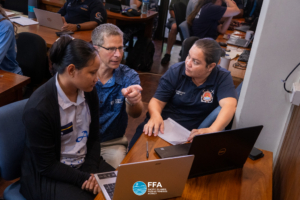
The operation involved FFA Members who worked with partners in using tools like the FFA Regional Surveillance Picture (RSP), the Regional Information Management Facility (RIMF) and Starboard Maritime Intelligence to target high-risk vessels and coordinate surveillance assets. Photo: FFA
FFA Interim Deputy Director-General and Director of Fisheries Operations, Allan Rahari, congratulated OPRB26’s coordinating team based at the FFA RFSC in Honiara for the successful completion of the operation.
“Operation Rai Balang is part of FFA’s ongoing work to maintain compliance across the Pacific tuna fishery and combat illegal, unreported and unregulated fishing in the region,” Mr Rahari reminded.
“By conducting vessel inspections, analysing vessel activity and coordinating surveillance across our Members’ waters, we help ensure that fishing vessels operate within national laws set by our Members and abide by international fisheries rules. These efforts send a clear message that the Pacific region is actively monitoring its fisheries resources.
“During this operation we combined aerial patrols, vessel boardings, and advanced satellite and remote sensing tools to monitor fishing activity and areas of interest. This coordinated approach helps us identify high-risk vessels earlier and support timely enforcement actions by our Members.”
These coordinated surveillance efforts also align with the 2050 Strategy for the Blue Pacific Continent, reinforcing the region’s commitment to working together to protect ocean resources and ensure they continue to deliver benefits for Pacific people.
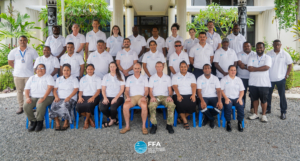
A group photo of Operation Rai Balang seconded participants that include Members, partners and the FFA Secretariat at the FFA Regional Fisheries Surveillance Centre in Honiara. Photo: FFA
Operation Rai Balang also involved close collaboration with regional and international partners, including technology providers and organisations supporting maritime domain awareness and fisheries monitoring.
The outcomes of the operation will now feed into follow-up investigations and compliance processes under regional and national fisheries management frameworks.
HONIARA, 16 MARCH 2026
| Media Contacts: Emily V. Moli FFA Communications Manager e: [email protected] Ernest Ta'asi FFA Communications Officer e: ernest.ta’[email protected] Priscilla Ragu FFA Communications Officer e: [email protected] |  |
| About Pacific Islands Forum Fisheries Agency (FFA) FFA assists its 17 Members to sustainably manage fishery resources that fall within their 200-mile Exclusive Economic Zones (EEZs). FFA provides expertise, technical assistance and other support to its members who make decisions about their tuna resources and participate in regional decision making on tuna management. Find out more here: www.ffa.int |
|
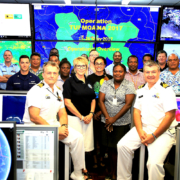
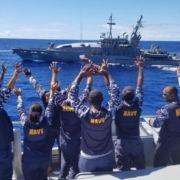 Photo credit: Fiji Navy