From Dunedin to the Pacific Table: Heather Ward Takes the Helm of Regional Fisheries Talks
Before she officially opened one of the Pacific’s most important fisheries meetings this week, Heather Ward began not with policy, politics or statistics – but with whakapapa.
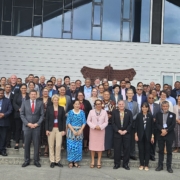
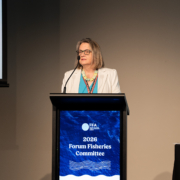
Standing before fisheries senior officials and delegates gathered at Te Papa Tongarewa in Wellington, Aotearoa New Zealand’s new Forum Fisheries Committee (FFC) Chair introduced herself first in te reo Māori, acknowledging where she comes from and the place she now calls home.
“My ancestors are from Scotland. I was born in Dunedin, I grew up in Dunedin, and I now live in Wellington,” she told delegates warmly.
It was a simple but grounding introduction – one that reflected the tone Ms Ward would carry throughout her opening remarks as New Zealand officially assumed the Chair of the Forum Fisheries Committee Officials Meeting.
There was warmth, humour, gratitude and realism.
And perhaps most importantly, there was a clear understanding that the Pacific fisheries conversations happening this week are ultimately about people.
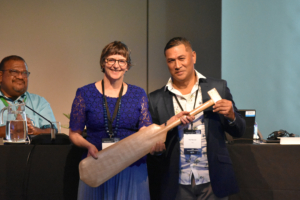
Outgoing FFC Officials Chair, Poi Okesene of Niue Fisheries, hands over a paddle to Heather Ward of the New Zealand Ministry for Primary Industries, symbolising the handover of the FFC Chair from Niue to New Zealand for the next 12 months. Photo: New Zealand Ministry for Primary Industries
Ms Ward paid heartfelt tribute to outgoing Chair Poi Okesene of Niue, praising his leadership during a demanding year for the region.
“As Chair, Poi Okesene performed this role with absolute distinction,” she said.
She joked that Okesene’s rugby background may have helped him navigate some of the region’s toughest negotiations, particularly the discussions around the allocation framework for South Pacific albacore.
“No doubt drawing on his rugby skills to tackle those difficult issues,” she said, drawing laughter around the room.
The light moment reflected the strong relationships that have developed among Pacific fisheries leaders and officials over years of negotiations, long meetings and shared regional challenges.
Ms Ward also acknowledged the generosity shown by Niue when it hosted last year’s meetings.
“It is certainly a tough act to follow,” she admitted.
But behind the humour, sat the reality of what lies ahead.
As New Zealand takes on the Chair role, Ms Ward made it clear that Pacific fisheries leaders are entering a critical period – one that will require difficult decisions, strategic thinking and regional unity.
“Members, we have our work cut out for us this week,” she said.
Among the major issues on the table are reforms following the independent KPMG review of the FFA Secretariat, questions around long-term funding, recruitment of a new Deputy Director-General, and finalising the FFA Strategic Plan for 2026-2031.
On the fisheries side, the region continues to tackle major tuna management decisions, including implementation work for South Pacific albacore and ongoing negotiations around bigeye tuna management.
Ms Ward acknowledged that balancing the impacts of purse seine and longline fisheries, remains one of the more complex conversations facing Members.
But while the discussions are technical, the impacts are deeply personal for Pacific countries.
“The current global context cannot be ignored,” she said.
She pointed to rising fuel prices and uncertainty linked to the Middle East crisis, warning that global events continue to have direct consequences for Pacific fisheries operations, governments and communities.
At the same time, Pacific nations are continuing efforts to increase the value they receive from tuna resources that remain central to the region’s economies and livelihoods.
Throughout her remarks, Ms Ward repeatedly acknowledged the people working quietly behind the scenes to make the meeting possible – from officials in New Zealand’s Ministry for Primary Industries to the FFA Secretariat staff coordinating the complex week-long programme.
She singled out Members of her own team for their “relentless cheerfulness and remarkable efficiency,” drawing appreciative smiles from colleagues in the room.
It was a reminder that regional fisheries diplomacy is not only shaped by ministers and negotiators, but also by the many officials, advisers and support staff whose work often goes unseen.
As she formally declared the 142nd Forum Fisheries Committee Officials Meeting open, Ms Ward struck a tone that balanced seriousness with optimism.
The agenda ahead may be heavy – governance reform, climate pressures, fisheries management, monitoring systems and regional negotiations – but there was also a strong sense that Pacific cooperation remains one of the region’s greatest strengths.
And in many ways, Ms Ward’s opening remarks reflected exactly that: grounded leadership, respect for relationships, and a steady focus on the collective future of the Pacific Ocean and the people who depend on it.
WELLINGTON, 12 MAY 2026
| Media Contacts: Emily V. Moli FFA Communications Manager e: [email protected] Ernest Ta'asi FFA Communications Officer e: ernest.ta’[email protected] Priscilla Ragu FFA Communications Officer e: [email protected] |  |
| About Pacific Islands Forum Fisheries Agency (FFA) FFA assists its 17 Members to sustainably manage fishery resources that fall within their 200-mile Exclusive Economic Zones (EEZs). FFA provides expertise, technical assistance and other support to its members who make decisions about their tuna resources and participate in regional decision making on tuna management. Find out more here: www.ffa.int |
|