Ika Moana Rises Again – Strengthening Pacific Leadership in Maritime Surveillance
The Pacific Ocean is vast and full of potential. It is a resource that Pacific peoples have long relied on, which makes protecting it an important responsibility.
Flashback to 2014, four Members, Cook Islands, Samoa, Niue, and Tonga, decided to take on this sub-regional level subregional joint surveillance, marking a significant step in the ownership of maritime surveillance in the region. The responsibility to lead would rotate among the four Members.
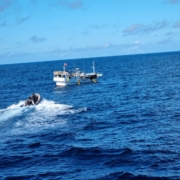
Two Police Patrol boats used as part of Operations Ika Moana. Photo: OPIM25 Media
Typically, maritime surveillance was carried out from the Regional Fisheries Surveillance Centre (RFSC) at the FFA in Honiara, Solomon Islands, so this was a huge step, not only for maritime surveillance, but for Pacific leadership. It signalled the potential for increased multilateral cooperation and relationship-building to protect ocean resources. The operation enabled participating Members to coordinate surveillance across their EEZs.
Recognising the Secretariat’s years of experience, resources, and network, the Members invited it to support the coordination and execution of operations in 2018 and 2019. However, COVID-19 had other plans, and the initiative was halted.
But the Pacific has a way of bringing back what was once lost. Operation Ika Moana was not meant to lie at the bottom of the ocean forever. After a five-year hiatus, Operation Ika Moana was reactivated by the Samoa Government in Apia. This comeback was not just about a “return to operations.” It was personal, a return to rebuilding connections and confidence in national leadership and sub-regional coordination.
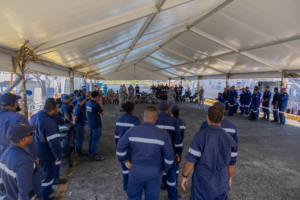
Daily briefing during the operation. Photo: OPIM25 Media
In August 2025, Operation Ika Moana was set in motion. The Secretariat was once again invited by the Samoa Police Commissioner to provide coordination and operational support. Drawing on its experience and resources, it delivered targeted support. This included Maritime Domain Awareness (MDA) Watchkeeper training, coordination of aerial surveillance through the FFA Aerial Surveillance Program, application of satellite remote sensing technology, and facilitation of boarding inspection refresher training for all participating Members. Working closely with partners such as AFMA, MPI, and the Fiji Navy, the Secretariat ensured that support responded directly to the needs identified by the Samoa Joint Coordination Centre (JCC) at the Maritime Police Headquarters.
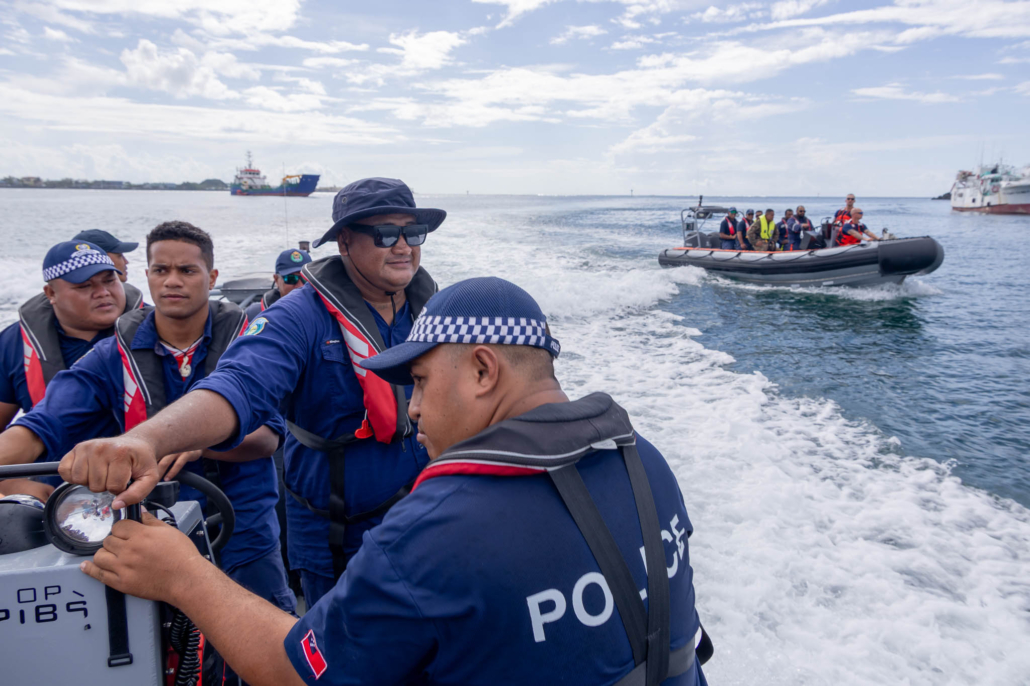
As Operation Ika Moana gained full momentum, Watchkeepers strengthened their ability to monitor and analyse information in real time. The JCC took on the role of coordinating multiple patrol assets, including six Guardian-class patrol boats (GCPB), and air assets while also supporting intelligence analysis and operational decision-making. Boarding officers refreshed their skills, ensuring that inspections at sea and in port were carried out with consistency and confidence.
Results soon became visible: seven vessel boarding were conducted, three sightings were recorded, and three vessels of interest were identified. Satellite remote sensing added another layer of capability, contributing to eleven detections. Altogether, the operation covered more than 90,000 square kilometres, demonstrating what can be achieved when national efforts are aligned and supported.
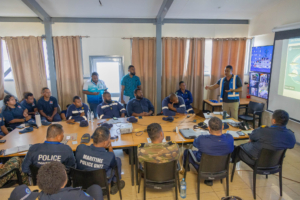
Yohni Fepuleai, leads a training session during the operation. Photo: OPIM25 Media
For Yohni Fepuleai, a Surveillance Operations Officer with the Pacific Islands Forum Fisheries Agency (FFA) who had been involved in establishing Operation Ika Moana before joining the Secretariat, the operation carried a deeper meaning:
“The power of Pacific leadership and networking among FFA Members to work together. This operation brings together Members, GCPBs, and MCS officers for joint surveillance and training exercises.
Operation IKA MOANA sets a new standard for Regional Cooperation and Pacific Unity in Maritime Surveillance.
It creates the opportunity for Members to lead, coordinate, and execute a multilateral operation themselves, rather than relying on FFA as the coordination centre. It is about empowering national headquarters to take on that role, particularly within sub-regional groups with shared interests.”
Operation Ika Moana represents a shift in how operations are led. Samoa’s Joint Coordinating Centre was not just participating, it was driving the operation, coordinating assets, analysing information, and making decisions in real time. The Secretariat played a supporting role, providing technical expertise while allowing national systems and leadership to take the lead.
This shift strengthened not only technical capacity, but also the confidence and ability of the host nation to lead a complex, multilateral surveillance effort. It demonstrated that, with the right support, Members can coordinate effectively across borders and manage operations that respond to shared maritime security priorities at the sub-regional level.
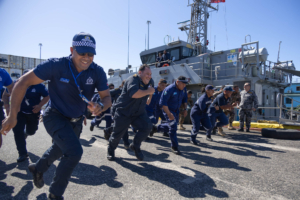
Operation Ika Moana demonstrates that the Pacific is resilient and strong. Our ocean is what binds us and it is also what ensures we are never lost. Photo: OPIM25 Media
With this renewed momentum, Operation Ika Moana is set to continue in the future, with either Cook Islands or Tonga taking the lead, alongside continued support from the Secretariat, Pacific Maritime Security Program (PMSP) and partners. The focus on building Member-led coordination and sustaining progress remains.
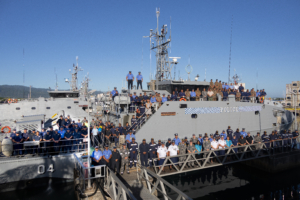
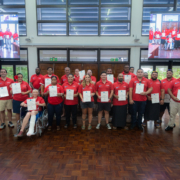
A group photo of all participants of Operation Ika Moana 2025 onboard NAFANUA III in Apia, Samoa. Photo: OPIM25 Media
Operation Ika Moana demonstrates that the Pacific is resilient and strong. Our ocean is what binds us, and it is also what ensures we are never lost. This revival is a testament to the Pacific’s sense of ownership, pride, and responsibility to protect what is rightfully theirs.
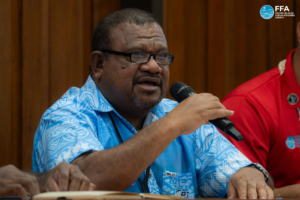
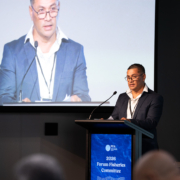
FFA Director-General Noan David Pakop. Picture: FFA
FFA Director-General Noan David Pakop said: “The operation illustrates the value of flexible, host-driven regional exercises. By bringing together fisheries patrol vessels, law enforcement, corrections, and other maritime agencies under a unified command, the operation enabled participating countries to respond quickly to IUU fishing threats while also addressing wider maritime crimes.”
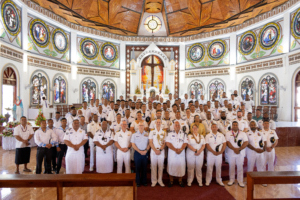
Group photo of all participants attending a Sunday mass in Samoa. Photo: OPIM25 Media
HONIARA, 18 JUNE 2026
| Media Contacts: Emily V. Moli FFA Communications Manager e: [email protected] Ernest Ta'asi FFA Communications Officer e: ernest.ta’[email protected] Priscilla Ragu FFA Communications Officer e: [email protected] |  |
| About Pacific Islands Forum Fisheries Agency (FFA) FFA assists its 17 Members to sustainably manage fishery resources that fall within their 200-mile Exclusive Economic Zones (EEZs). FFA provides expertise, technical assistance and other support to its members who make decisions about their tuna resources and participate in regional decision making on tuna management. Find out more here: www.ffa.int |
|