A town built by tuna: FFA Head visits Noro’s unique tuna hub
There is only one place in the Pacific where purse seine, longline and pole-and-line fleets operate alongside a full tuna processing facility in the same port. That place is Noro.
Located in the New Georgia region of Solomon Islands Western Province, Noro is the province’s busiest township. It hosts one of only two international shipping ports in the country and is only a 20-minute drive from the country’s second international airport at Munda.
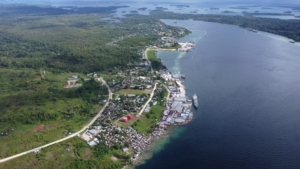
Noro is the busiest township in the Western Province, home to the country’s second international ports facility. Photo: SolTuna
On 10 November 2025, Solomon Islands Prime Minister Hon. Jeremiah Manele officially opened the Ministry of Fisheries and Marine Resources office in Noro, a data centre and a new police station, a modern complex facility built to support the townships law and order and growing population and economy.
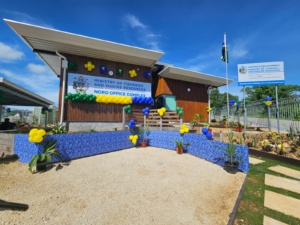
The new fisheries office in Noro. Photo: Solomon Islands Ministry of Fisheries and Marine Resources
These recent developments add to Noro’s expanding role as a commercial and industrial centre. But at the heart of the township’s growth are two major operations: National Fisheries Developments Ltd (NFD) and SolTuna Ltd.
NFD operates the country’s domestic tuna fleet that supplies the processing facility, whilst SolTuna operates the processing facility. Both companies are conveniently set up next to each other, creating a seamless flow from the moment fish is unloaded at the wharf, to the moment a finished product is canned, sealed and loaded into a container, the entire process takes place within a single port location.
This close-knit set up creates a unique industry environment that makes Noro the most vertically integrated tuna port in the Pacific.
The Pacific Islands Forum Fisheries Agency (FFA) Director-General, Noan David Pakop said this kind of integration reflects the development Pacific countries are striving for – bringing more of the tuna value chain onshore, creating jobs and strengthening national economies.
On 11 November 2025, Mr Pakop was on site at NFD and SolTuna operations in Noro for a courtesy visit.
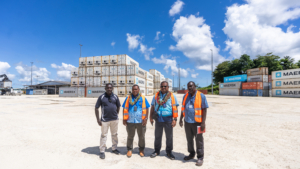
Visit to SIPA Noro Ports facility, from left; NFD Operations Manager Luxton Pitanoe, Solomon Islands Director of Fisheries Edward Honiwala, FFA Director-General Noan David Pakop, and SIPA Noro Ports Manager Moses Runikera. Photo: FFA
“Seeing the operations in person helps connect regional policies with what is happening on the ground,” he said. “The investments here in Noro show a clear commitment to building capacity across the entire tuna value chain, from catching to processing and meeting global market standards.”
He added that this development and level of investment supports the wider regional goal of retaining more value from Pacific tuna within Pacific economies.
“It is encouraging to see that the work we promote at the regional level is already taking shape here in Noro. The developments here show how countries can retain more of the value from their tuna resources and create long term opportunities for their people.”
Mr Pakop was given a tour around the NFD operations base, which works closely with the Solomon Islands Ports Authority in Noro, as well as a walk through the SolTuna processing facility.
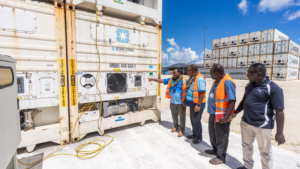
The FFA Director-General and Solomon Islands Fisheries Director were taken through a brief tour around the NFD operations and SIPA Noro Ports facilities. Photo: FFA
While FFA works directly with national fisheries authorities across its 17 Members, the Director-General emphasised that industry partners play a critically important role. “They bring the investment, capacity and technical expertise that turn policy into practical results.”
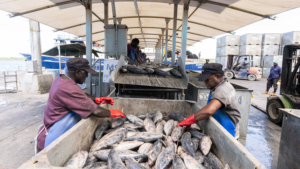
Tuna are offloaded from an NFD vessel and directly onto SolTuna’s processing line. Photo: FFA
Mr Pakop noted that the growth in Noro aligns closely with the direction set by the Forum Fisheries Committee (FFC), particularly through the East New Britain Initiative (ENBi) – a flagship regional initiative designed to strengthen processing hubs, support onshore value adding, improve infrastructure and help countries keep a greater share of tuna value.
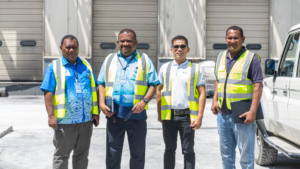
At the SolTuna cannery, from left; Fisheries Director Edward Honiwala, FFA Director-General Noan David Pakop, SolTuna Operations Manager George Dalagan, and SolTuna Health, Safety and Environment Manager Isaiah Alepio. Photo: FFA
“While we promote this at the regional scale, it’s encouraging to see companies like SolTuna and NFD already investing in ways that match this approach. The scale of development here in Noro mirrors what the ENBi is driving across the region.”
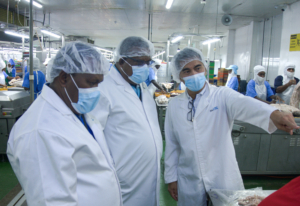
The FFA Director-General Noan David Pakop and Solomon Islands Fisheries Director Edward Honiwala were taken through a tour in SolTuna’s processing plant. Photo: SolTuna
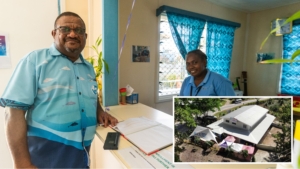
FFA Director-General Noan David Pakop took the opportunity to visit SolTuna’s Pikinini Kea Haus, a child daycare center for SolTuna employees. Mr Pakop is pictured signing in to the centre. Photo: FFA
Mr Pakop was accompanied by the Solomon Islands Director of Fisheries, Edward Honiwala, who said the visit strengthened the government’s understanding of Noro’s growing industrial base and the need to support its long-term stability.
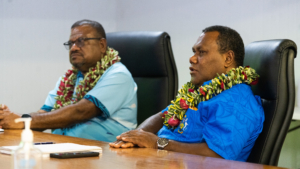
Director of Fisheries for the Solomon Islands Ministry of Fisheries and Marine Resources, Edward Honiwala, at a briefing with NFD during the Noro visit. Photo: FFA
“The government’s support is very important, especially in helping build confidence in the investments being made,” he said acknowledging the new fisheries office in Noro. “The economic contribution of this industry, particularly through employment and national revenue, is something the country relies on.”
He said sustainability must apply not only to the tuna resource but also to the companies that depend on it.
“For us to create the right environment for them to operate in, it is important to understand their work and the challenges they face. These are important takeaways from this visit,” he said.
Mr Honiwala highlighted the significant investments underway, including SolTuna’s plans for a new powerhouse and new 6,000-tonne cold storage facility – an investment of US$18 million according to SolTuna.
“These are big investments, and the government has a responsibility to give assurance and support. While they invest more, they must also be confident that their investment is secure.”
Currently, NFD and SolTuna together contribute around 3% percent of Solomon Islands’ national GDP. The country harvests around 100,000 metric tonnes of tuna a year, with SolTuna producing close to one third of that – between 25,000 and 30,000 metric tonnes annually.
“When you look at that 30 percent, and the employment and infrastructure it creates, it is a major contribution,” Mr Honiwala added. “Our hope is that the remaining 70 percent can one day be treated in the same way as what is happening here in Noro.”
Noro is also home to the Pacific’s first “e-port” system, launched in June 2021, which uses digital catch-documentation and traceability tools to track tuna from unloading through processing to export. This system is part of a partnership between the Solomon Islands government, industry and regional agencies and supports the integrity of the country’s tuna value chain.
“You see the infrastructure here [in Noro] is because of tuna,” Mr Honiwala acknowledged. “And with the new fisheries office, the level of support we can give to investors in Noro will improve.”
SolTuna remains the country’s largest private sector employer, with more than 1,800 workers and over 60 percent are women.
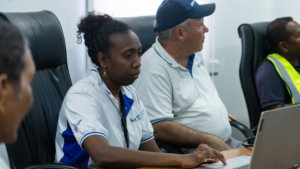
SolTuna Admin Officer Cathy Zesapa, and SolTuna Plant Engineer Steve Porteus, during a meeting with the FFA Director-General. Photo: FFA
Although NFD and SolTuna operate as separate companies, both are majority owned by Bolton Group – an Italian family-owned multinational company known for its canned fish and consumer products. Other SolTuna shareholders include the Solomon Islands National Provident Fund, the Investment Corporation of Solomon Islands and the Western Provincial Government.
The Noro tuna operations are part of a wider global network of tuna processing plants operated by Bolton Group across Spain, Italy, Colombia, Ecuador, Morocco and the Solomon Islands.
In the words of SolTuna General Manager Rakesh Deehoo: “Our people are at the heart of SolTuna. Every bag of frozen loins and every can that leaves our factory represents the hard work, dedication and teamwork of our employees.”
Former Chairman Adrian Wickham says that it is important that policy makers at every level, be it government or regional agencies like FFA, understand the implication policies have on the operations and profitability of companies such as NFD and SolTuna.
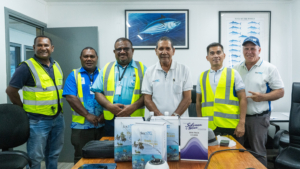
Visiting the SolTuna main office. From left; SolTuna Health, Safety and Environment Manager Isaiah Alepio, Solomon Islands Director of Fisheries Edward Honiwala, FFA Director-General Noan David Pakop, former Chairman Adrian Wickham, SolTuna Operations Manager George Dalagan and SolTuna Plant Engineer Steve Porteus. Photo: FFA
As Pacific countries push to retain more value from their tuna resources, Noro stands as a tangible example of how regional aspirations translate into real on-the-ground outcomes.
The integrated operations of NFD and SolTuna reflect the vision of the East New Britain Initiative – aiming for more onshore processing, more local jobs, better infrastructure and stronger economic returns for Pacific economies.
With government, industry and regional agencies moving in the same direction, Noro’s growth demonstrates how Solomon Islands is helping to lead this shift, building a more resilient and more valuable tuna sector for the Pacific.
FFA Members are: Australia, Cook Islands, Federated States of Micronesia, Fiji, Kiribati, Marshall Islands, Nauru, New Zealand, Niue, Palau, Papua New Guinea, Samoa, Solomon Islands, Tokelau, Tonga, Tuvalu and Vanuatu.
| Media Contacts: Emily V. Moli FFA Communications Manager e: [email protected] Ernest Ta'asi FFA Communications Officer e: ernest.ta’[email protected] Priscilla Ragu FFA Communications Officer e: [email protected] |  |
| About Pacific Islands Forum Fisheries Agency (FFA) FFA assists its 17 Members to sustainably manage fishery resources that fall within their 200-mile Exclusive Economic Zones (EEZs). FFA provides expertise, technical assistance and other support to its members who make decisions about their tuna resources and participate in regional decision making on tuna management. Find out more here: www.ffa.int |
|